

Summary and commentary provided by John Ambrose on behalf of Complete-Careers LLP

Introduction
The Gatsby Foundation published ‘Good Career Guidance – The Next 10 Years’ on 18th November 2024. The research was led by Ryan Gibson as Senior Adviser, supported by International Centre for Guidance Studies (ICEGS). The review involved an online consultation (1200 respondents), interviews with sector experts, literature review, analysis of compass data, case studies, visits and roundtables. (p8)
The research is 10 years after the original ‘Good Career Guidance was released, which had an enormous impact on careers provision in England: the DfE adopted the benchmarks into policy in 2018, Ofsted references it in the inspection and the Careers and Enterprise Company was commissioned to support schools and colleges in England towards the benchmarks through resources such as Compass, Career Hubs and Career Leader training.
The 2024 report states how 4700+ schools and colleges (90%) are using the benchmarks, achieving on average 5.8 of the 8 benchmarks in 2024 (p7). It presents how 94% of respondents saw the benchmarks as a valuable framework for careers guidance, with no benchmark considered significantly more important than any other.
Headlines
The report provides stability retaining the number of benchmarks at eight and the wordings exactly the same, with updates to the summary and measurable criteria.
It identifies five themes that emerged from the overall evidence:
- Careers at the heart of education and leadership (whole school approach, connectivity with strategic vision/plans and distinct responsibilities for leadership, careers leaders, advisers and governors).
- Inclusion and impact for each and every young person (tailoring programmes to needs, considering vulnerability, disadvantage and SEND).
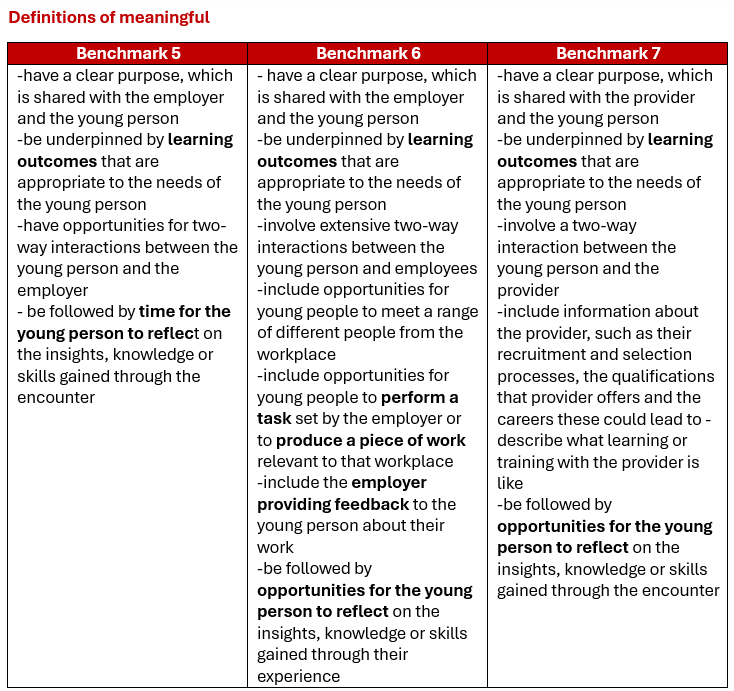
- Meaningful and varied encounters (expanded definition of ‘meaningful’ in GBs 5, 6 & 7, providing greater variety and the opportunities to review and reflect from encounters)
- Focus on the use of information and data (data collection has been refocused to include aspirations and intended destinations).
- Engagement of parents and carers (embed parent and carer engagement into planning and provide them with information to support their children).
Key observations
- The focus is now clearly for secondary schools, colleges and independent training providers (ITPs)
- Parents and carers section more prominent in Gatsby benchmark 1
- Heightened focus on strategic alignment to overall organisational vision, now referencing headteachers and governors alongside senior leaders
- Focus on intent, with learning outcomes referred to throughout, as well as learner reflection time
- Measure to track destinations 3 years after students have left has now gone, focussing instead on ‘current learners and recent leavers’
- 3 separate definitions of ‘meaningful’ for Gatsby Benchmarks 5,6 and 7
- The report sets out separate measures for schools (p30-31) and colleges/ITPs (p.32-34).
Criteria changes
Gatsby Benchmark 1:
Significant criteria changes:
- Explicit backing of SLT is expanded to include governors and headteacher, and career leader should be identified and appropriately trained
- New measure: ‘The careers programme should be tailored to the needs of pupils, sequenced appropriately, underpinned by learning outcomes and linked to the whole-school development plan. It should also set out how parents and carers will be engaged’ (p.29)
- careers advisers referenced as a source to evaluate the effectiveness of the career programme (alongside learners, parents, teachers and employers – as previous).
Gatsby benchmark 2
Significant criteria changes:
- ‘during each key stage all pupils should access and use information about careers, pathways and the labour market to inform their own decisions on study options or next steps’ (p.29) This was previously only by the age of 14 and didn’t include ‘next steps’.
Gatsby benchmark 3
Significant criteria changes:
- Systematic records – this was previously for individual advice given to each pupil, but now covers ‘the participation of pupils in all aspects of their career programme’ (p.30)
- New measure – following on from the above there is a criterion for the information to be shared when pupils change school during the secondary phase (p.30)
- The guidance on tracking for three years after leaving has gone and is replaced with recording aspirations, intended and immediate destinations. In addition, schools are expected to ‘use sustained and longer-term data as part of their evaluation process and use alumni to support their careers programme’ (p.30)
Gatsby benchmark 4
Significant criteria changes:
- Now expected in every year and in every subject while also highlighting the knowledge and skills pupils develop and not just career routes.
- New measure: ‘Careers should form part of the school’s ongoing staff development programme for teachers and all staff who support pupils’. (p.30)
Gatsby benchmark 6
Significant changes:
- Previous measure used to be at least one experience of a workplace by age 16 and further experience by 18, excluding part-time jobs. Now the measure states ‘meaningful experiences’ but no longer discounts part-time work.
Gatsby benchmark 8
Significant changes:
- As before but language changed from ‘interviews’ to ‘meetings’ and now states ‘meetings should be scheduled in the careers programme to meet the need of pupils ‘ (p.31)
- New measure: ‘Information about personal guidance support and how to access it should be communicated to pupils and parents and carers, including through the school website.’ (P.31)
- Amended measure: For over-16s who are in a school sixth form, this benchmark now matches those for over-16s at a college or independent training provider (ITP). Benchmark 8 for schools now states that every young person should have a further meeting by the age of 18, where it previously required them to have the opportunity for a further meeting.’ (p.98)
Colleges and Independent Training Providers
Pages 32 and 33 set out the criteria for colleges and independent training providers, as pages 30 and 31 does for schools. In the main the measures are similar; however some may present challenges to include:
Gatsby benchmark 3 (records)
‘The records of participation and advice given should be integrated with those given at the previous stage of the learner’s education (including their secondary school), where these are made available. Records should begin to be kept from the first point of contact or from the point of transition.’ (p.33)
Gatsby benchmark 6 (experiences of the workplace)
Unlike with schools, the measure quantifies the number of experiences of the workplace as ‘at least one in addition to any part-time jobs they may have’.
Gatsby benchmark 8 (personal guidance)
States that every learner should have at least one personal guidance meeting with a careers adviser. Colleges have already been working to this (though how practical it may be in a large FE college could be questioned), but this also explicitly applies to independent training providers.
Recommendations in the report
The report concludes with the following 10 recommendations (p.103):
- ‘The government retain the Gatsby Benchmarks as the national standard for careers guidance.’
- ‘Ofsted continue to use the benchmarks to inform their understanding of what good looks like for careers’
- ‘The government continue to invest in existing careers guidance infrastructure’ (CEC support)
- ‘National infrastructure should be funded for periods of at least three years at a time’
- ‘The government should consider how best to ensure young people studying in ITPs and those following an apprenticeship can access good careers guidance’
- ‘National guidance, based on the core principles of the benchmarks, should be developed to help shape tailored local provision for young people out of formal education’
- ‘Improvements could be made to provide sustained and longer-term destination data to schools, colleges and ITPs in a more timely way.’
- ‘Government-assured labour market information (LMI) should continue to be provided to schools and colleges in a way that helps them look at different occupations and larger economic trends’
- ‘Education leaders should be supported to understand the impact careers guidance has on outcomes for young people’
- ‘Consideration should be given to how all careers advisers working with young people could join the Career Development Institute (CDI) register of career development professionals.’
Commentary and analysis
With the positioning of the benchmarks central to policy documentation in England since the 2018 statutory guidance, the 2014 ‘Good Career Guidance’ report was always going to be a tough act to follow. The benchmarks are a common language amongst schools and the 2024 report highlights how the vast majority of schools and colleges are using them and value doing so.
The essence of the 2024 report is ‘stability’, retaining the eight benchmarks and keeping the language exactly the same. This might surprise or even disappoint some career professionals, but it is important to manage expectations. None of the eight benchmarks look out of place or inappropriate. Many may feel that certain aspects of career guidance deserve a benchmark e.g. parents and carers, but where do you stop?
It is essential to recognise the benchmarks can’t define all things to all organisations. They are a series of outputs to structure a programme. Author of the original 2014 report Sir John Holman even stated ‘the benchmarks alone are not enough’ in the foreword to Andrews and Hooley’s Career Leader Handbook. The benchmarks alone are not policy either as far broader elements are included in the current statutory guidance for schools.
The new five themes are a welcome addition to sharpen the focus moving forward. Careers has to be a strategic priority in any organisation and it is great to see the need to align careers with the strategic mission/values/ethos etc of the organisation, as well as reference the Head teacher and governors explicitly. Tailoring resources for those who needs more support is also welcomed, as well as help and support for parents and carers. It is also pleasing to see support for Career Leaders who have needed help for years in defining ‘meaningful’ as well as abandoning an almost impossible task of collecting destination records for all learners up to three years after leaving!
Learning outcomes and reflection time are also most pleasing to see. As part of any strategic approach to careers requires clear intent provided by planned and progressive learning outcomes. It is good to see this as a new feature of benchmark 1, as well as references throughout benchmarks 5, 6 and 7. What is most surprising however is the omission of reference to the CDI framework. This is free and presents suggested learning outcomes from early years through to key stage 5 under six overarching aims. The framework has evolved overtime capturing decades of occupational choice and transition theories. It is non-statutory, but provides valuable help and support for many Career Leaders to help adapt an existing framework, rather than start from scratch for their organisation. https://www.thecdi.net/resources/cdi-framework
Under the definitions of encounters and experiences there is now clear reference to ‘opportunities for the young person to reflect on the insights, knowledge or skills gained through their experience’. Could this see a return to much needed dedicated time in the curriculum for careers education, alongside cross curricular links?
Labour Market Information or Intelligence? Whilst benchmark 2 remains (learning from career and labour market information) it is surprising to see artificial intelligence and the hugely anticipated imminent disruption to work as we know it, referenced only once. Surely at least the ‘I’ in LMI could have shifted from ‘information’ (the data) to ‘intelligence’ (interpretation and meaning in a current and future context)?
Career meetings, not interviews: This is a really important shift in the language we use around personal guidance. Guidance is personal, it is informal and the language should reflect this. It was also pleasing to see time to prepare for guidance included in the report, as well as to acknowledge the challenges the profession is facing currently for the future pipeline. The section fell short of setting the requirement to be trained in guidance at level 6/7, but it did refer to the CDI’s professional register.
Confusion over personal guidance expectations post 16. From the criteria change for GB8 above you can see the quotation about criteria change to bring schools with 6th forms aligned to colleges and independent training providers about an EXPECTATION for a further meeting by age 18. It is however unclear where this original ‘expectation’ for colleges and training providers came from. It wasn’t in the original 2014 report, now is it in the current statutory guidance for schools and colleges.
Quality in Careers Standard is referenced in page 43 of the report. This is pleasing to see, albeit short. The national data continues to highlight how schools and colleges with the Quality in Careers Standard achieve the highest Compass scores nationally. No mention of this in the report seems remiss. https://www.qualityincareers.org.uk/2024/01/10/quality-in-careers-award-holders-achieve-highest-compass-scores-nationally/ The fact a significant proportion of the schools and colleges in the case studies throughout the report are award holders adds to the confusion.
Careers outside formal education. The benchmarks provide an entitlement for young people, but unfortunately only those in formal education settings such as schools, colleges and independent training providers. What about those who fall outside? It is welcome to see a recommendation to support local provision to explore ways to bring the benchmarks to all young people.
Leading language: there are areas of the report where it is important to apply balance and perspective. Lord Sainsbury for example states that ‘we now have a career guidance system as good as any other country’ (p.3). I am not sure if we truly have the evidence to make such a claim? We need to recognise that without funding the system is only world-class on paper, rather than in practice.
The report also makes various claims in places about pupils’ ‘Career Readiness’. This is later defined as ‘a measure of how prepared they (young people) are for future decisions and work’. It must be recognised however that this is a learner self-perception snapshot, rather than evidenced.
Where is the money? One of the highlights of the original 2014 ‘Good Career Guidance’ report for me was the work PricewaterhouseCoopers (PwC) complied on the cost to implement the benchmarks. This was estimated as £207 million in the first year and £173 million thereafter. It was estimated to cost a medium school outside of London £53637 in the first year, followed by an annual cost of £44676. This money never materialised but is desperately needed. The 2024 report does however reference the return on investment research stating how for every £1 of investment in personal guidance the government can expect to recoup at least £3 because of the lifelong earnings, the decrease in NEET and decrease in HE dropout rates. (p.97)
And finally, we need to digest the report, come to our own conclusions and consider the impact for our organisation and most importantly our learners. There is clearly much to celebrate in the report and much to build upon as a foundation for the next ten years.
It is clear that the report will be central once more to policy. ‘I am pleased to reaffirm the government’s commitment to the Gatsby Benchmarks as the bedrock of our strategy to provide high-quality careers guidance to all young people.’ RT Hon Baroness Smith (Minister for Skills) (p.5). Now civil servants will be busy working on the updated statutory guidance for schools, colleges and independent training providers and we anticipate this will be ready in time for September 2025 implementation. The Careers and Enterprise Company will revise and update the Compass Tool and Career Impact System and the Quality in Careers Standard will review its national criteria ready for the new academic year.
Please strive to continue to do the very best you possibly can for the learners in your organisation with the resources and means you have available.
John Ambrose
Director
Complete-Careers LLP
November 2024
Sign up to our half-termly free newsletters here: https://complete-careers.com/sign-up-to-mailing-list/
References:
Good Career Guidance, (2024) Gatsby Foundation: https://www.gatsbybenchmarks.org.uk/app/uploads/2024/11/good-career-guidance-the-next-10-years-report.pdf
Good Career Guidance (2014), Gatsby Foundation: https://www.gatsby.org.uk/uploads/education/reports/pdf/gatsby-sir-john-holman-good-career-guidance-2014.pdf
CDI Framework, (2021) Career Development Institute: https://www.thecdi.net/resources/cdi-framework
Quality in Careers Standard: https://www.qualityincareers.org.uk/2024/01/10/quality-in-careers-award-holders-achieve-highest-compass-scores-nationally/
Investing in Careers, (2023), University of Derby: https://repository.derby.ac.uk/item/9zx1v/investing-in-careers-what-is-career-guidance-worth